As the CLARITY Act Stalls in the U.S., Crypto’s Regulatory Tailwind May Be Evaporating
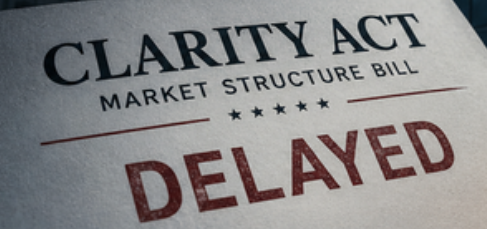
As prospects dim for passage of the CLARITY Act — the bill meant to overhaul the U.S. regulatory framework for digital assets — this year, downward pressure is building across crypto markets. The core concern isn’t just short-term price weakness; it’s the possibility that the longer this legislative gap persists, the more the eventual gains from tokenization could flow not to public blockchains, but to the traditional financial system dominated by banks and asset managers.
According to industry sources on July 31, JPMorgan identified the delayed CLARITY Act as a major headwind for crypto markets, noting that prediction markets currently price the odds of passage this year at just 37%. The bill is designed to divide oversight authority between the SEC and the CFTC based on the nature of a given digital asset, while establishing clear standards for exchanges, custodians, and other market participants — replacing a regulatory approach that has largely relied on ad hoc determinations by individual agencies.

Uncover incredible deals and embrace a seamless shopping spree on Temu! 😊
👉 item link: https://temu.to/k/pn26winzsfa
🎉 Coupon price[$122.03]
VEVOR Retractable Garden Hose Reel, 1/2 inch / 5/8 Inch x 65ft / 85ft / 100ft Wall Mounted, Heavy Duty with 9-Pattern Nozzle, Adjustable Length Lock, Upgraded Slow Return System & 180° Swivel Bracket
🚀 Help Me Earn Instantly — Just 1 Click!
Hi! Join Temu’s affiliate program via my link—it’s free. I’ll earn up to $50, and you’ll get free rewards instantly! 🎉
💡 Commission Boost: Your commission auto-upgrades to 35% after signing up!
🔗 https://temu.to/k/p590cevtkpa
inc151317
JPMorgan’s analysis suggests that as expectations for passage fade, one of the crypto market’s central policy tailwinds is losing its force. For banks and asset managers to enter crypto trading, custody, or tokenization businesses at scale, they need clarity in advance about which regulator has jurisdiction and which rules apply. The longer the bill remains stalled, the higher the legal costs and regulatory risk financial institutions must absorb — which in turn can delay institutional capital from entering the market in the first place. Without clearly defined regulatory boundaries, financial firms have little choice but to take a conservative approach to launching new products or deploying capital. For a market that has long counted on institutional inflows as a key growth driver, the legislative gridlock itself becomes a headwind weighing on investor sentiment.
As policy momentum weakens, the market becomes more sensitive to short-term supply-and-demand variables — interest rates, the dollar, and spot ETF flows — simply because there are fewer medium- and long-term catalysts left to support prices.
The implications of the delay extend beyond price action alone. JPMorgan raised the possibility that even as tokenization and blockchain-based financial services continue to expand, public blockchains themselves may not be the ones benefiting from that growth. If banks and asset managers build their tokenization businesses on proprietary systems or permissioned blockchains instead, transaction and settlement demand would stay contained within the existing financial system. In other words, digitizing real-world assets like stocks, bonds, or real estate wouldn’t necessarily translate into greater usage of, or token demand on, networks like Bitcoin or Ethereum.
From a financial institution’s perspective, there’s also a growing incentive to choose a controllable, proprietary network over a public blockchain whose regulatory treatment remains unclear — effectively adopting crypto-adjacent technology while avoiding dependence on token prices or open, permissionless networks.
Industry participants have noted that the longer the CLARITY Act remains stuck, the more likely institutional capital is to flow toward the traditional financial system — where regulatory compliance is more straightforward — rather than toward public blockchains. As one industry source put it, while the U.S. Congress spends time deliberating, leadership in the tokenization market could end up shifting to Wall Street instead.

Taken together with the broader CLARITY Act narrative — the confirmed but uncertain Senate vote, the 60-vote threshold, and the unresolved sticking points around stablecoin yield and ethics provisions — this JPMorgan analysis adds a structural dimension to the debate. It’s not just about whether XRP, Bitcoin, or other tokens see a short-term dip if the bill fails; it’s about whether the entire tokenization wave currently reshaping finance ends up captured by public, permissionless blockchains or gets absorbed into the walled gardens of traditional banking infrastructure instead. With prediction markets now pricing passage odds in the 30s, that structural question looks increasingly live.